
Quick Answer
To send money abroad from India, choose a transfer method such as a bank, an authorized dealer or an online platform, complete KYC verification, submit the required documents including PAN and identity proof, and confirm the purpose of the transfer falls within RBI’s Liberalised Remittance Scheme. Processing usually takes anywhere from minutes to a few business days depending on the method.
Introduction
More Indians are sending money abroad today than ever before, whether it is tuition for a child studying overseas, monthly living expenses, support for family or a payment for an international purchase. The process can feel intimidating the first time, with terms like LRS, KYC and outward remittance thrown around without much explanation.
Whether you’re paying overseas tuition, supporting family or making an international payment, understanding the process helps you save time, reduce costs and avoid mistakes. At ZeoForex we help people navigate exactly this every day, and this guide walks through the entire process step by step, from choosing a method to avoiding the most common errors.
TL;DR
- Sending money abroad from India requires KYC verification and falls under RBI’s Liberalised Remittance Scheme
- Common methods include banks, authorized dealers and online international money transfer platforms
- You will typically need PAN, identity proof, address proof and purpose specific documents
- Exchange rates, fees and processing time vary significantly between providers
- Always verify current RBI guidelines before initiating a large or unfamiliar transfer
What Does It Mean to Send Money Abroad from India?
Sending money abroad from India means transferring funds from an Indian bank account or payment provider to a recipient or account located in another country, generally involving a conversion from rupees into a foreign currency.
Domestic vs International Transfers
A domestic transfer stays within India and the rupee. An international transfer crosses both a border and usually a currency, which brings in exchange rates, KYC requirements and RBI regulations that a domestic transfer never touches.
Common Scenarios
This typically comes up when paying a university abroad, sending monthly support to a child studying overseas, helping family in another country, covering medical treatment abroad or making a payment for international business.
Common Reasons Indians Send Money Overseas
There are several legitimate and common purposes behind these transfers, including paying tuition fees directly to universities abroad, sending living expenses to children or family studying overseas, supporting relatives living in another country, covering medical treatment abroad, funding international travel, and business payments to overseas vendors or partners at a high level.
Can You Legally Send Money Abroad from India?
Yes, sending money abroad from India is legal and well regulated, provided it falls within the framework set by the Reserve Bank of India.
RBI’s Role in International Remittances
The RBI oversees how funds move out of India, setting the rules that banks and authorized dealers must follow for every outward remittance.
Liberalised Remittance Scheme Overview
The Liberalised Remittance Scheme, commonly known as LRS, allows resident individuals to send money abroad for permitted purposes such as education, medical treatment, travel and family maintenance, up to a limit set by the RBI. This LRS limit has historically been set at USD 250,000 per financial year, though the exact figure and applicable rules can change over time.
Who Can Send Money Abroad?
Resident individuals, including students and parents supporting them, are generally eligible to send money abroad under LRS, subject to KYC and documentation requirements.
Why Regulations Can Change
RBI guidelines are updated periodically, so a limit or rule that applied last year may not be current today.
Always verify the latest RBI guidelines or consult an authorized dealer before initiating a transfer, as regulations and limits may change.
Step-by-Step Guide to Sending Money Abroad from India
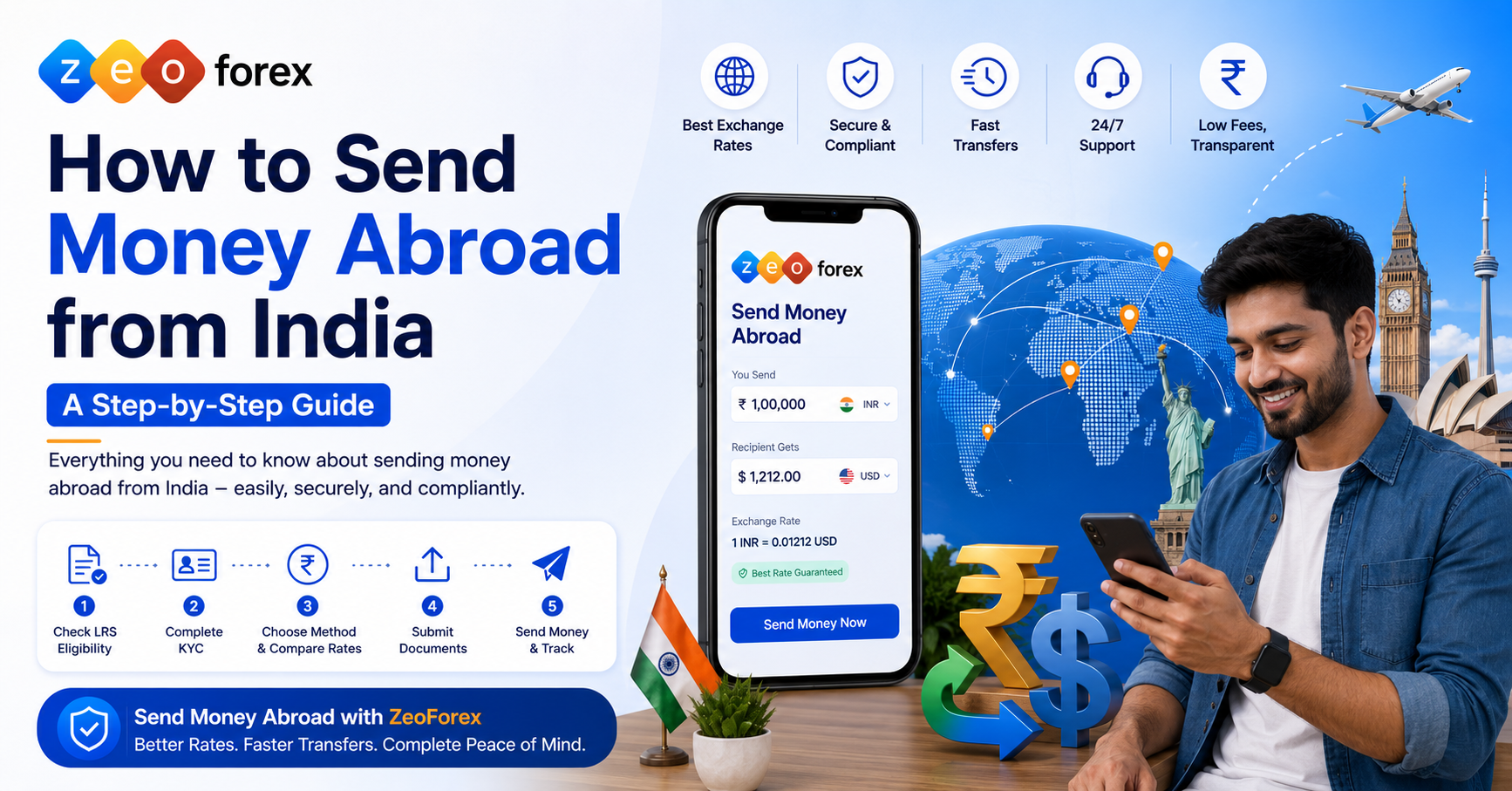
Here is what the process generally looks like from start to finish.
- Determine the purpose of the transfer, since this affects which documents you will need and which category it falls under
- Choose the right transfer method, whether that is a bank, an authorized dealer or an online platform
- Compare exchange rates and fees across a couple of providers before committing to one
- Complete KYC requirements, which usually means submitting identity and address proof once with your chosen provider
- Submit required documents, including anything specific to your purpose such as a tuition invoice
- Make the payment through your chosen method, whether that is net banking, a debit card or another supported option
- Track the transfer using the reference number provided until the funds reach the recipient
Common Ways to Send Money Abroad
Each method has its own trade offs in terms of speed, cost and convenience.
| Method | Typical Speed | Typical Cost | Best For |
|---|---|---|---|
| Bank transfer | 2 to 5 business days | Higher fees, weaker exchange rates | Large or formal payments |
| Online transfer platform | Minutes to 1-2 days | Lower fees, competitive rates | Regular personal transfers |
| Authorized dealer | 1 to 3 business days | Moderate fees | Transfers needing in person guidance |
| SWIFT transfer | 1 to 5 business days | Variable, may include intermediary charges | Bank to bank institutional payments |
1. Bank Transfers: Sending directly through your bank is familiar and trusted, often processed through the SWIFT network, though fees and exchange rate margins tend to be higher than digital alternatives.
2. Online International Money Transfer Platforms: An online international money transfer through a dedicated platform often means faster processing, more transparent pricing and better exchange rates than a traditional bank.
3. Authorized Dealers: Banks and non bank entities licensed by the RBI as authorized dealers can process outward remittances and are a common choice for those who prefer in person support.
4. SWIFT Transfers: SWIFT is the global network banks use to send payment instructions internationally. It is reliable but transfers can pass through intermediary banks, which sometimes adds cost and time.
Documents Generally Required for International Money Transfers
Having these ready in advance speeds up the process considerably: identity proof such as a passport, Aadhaar or voter ID, a PAN card which is mandatory for most outward remittances, address proof confirming your current residence, bank account details for both sender and recipient, and purpose specific documents such as a university tuition invoice or admission letter for education related transfers.
High Level Overview of LRS Limits and Compliance
Why LRS Exists?
The Liberalised Remittance Scheme exists to give individuals a straightforward, regulated way to send money abroad for approved purposes without needing case by case RBI approval, while still maintaining oversight of capital flows.
General Compliance Considerations
Transfers under LRS need to fall within an approved purpose category, and providers will typically ask you to declare this purpose as part of the KYC and documentation process.
Why You Should Verify Current RBI Guidance?
Limits, tax rules and reporting requirements tied to LRS have changed in the past and can change again, so it is worth checking with your bank, an authorized dealer or the RBI’s official resources before a transfer, especially a large one.
Factors That Affect Transfer Time
Several variables influence how quickly funds actually reach the recipient, including the transfer method chosen since online platforms are often faster than traditional bank transfers, the destination country as banking infrastructure varies significantly, the verification process which can take longer for first time transfers or larger amounts, banking holidays in either country, and how quickly the specific currency pair settles.
Factors That Affect Transfer Costs
Understanding what makes up the total cost helps you compare providers more fairly.
| Cost Component | What It Means |
|---|---|
| Exchange rate | The rate applied when converting rupees to the destination currency |
| Transfer fees | A fixed or percentage based fee charged by the provider |
| Receiving bank charges | Fees the recipient’s bank may deduct on arrival |
| Currency conversion costs | The margin a provider adds on top of the market exchange rate |
How to Choose the Right International Money Transfer Provider
A quick comparison across a few factors usually reveals the better option: compare exchange rates since this often affects total cost more than the advertised fee, review fees across a couple of providers for your specific transfer amount, check that the provider is RBI authorized and handles data responsibly, evaluate transfer speed based on how urgently the recipient needs the funds, assess customer support availability, and compare the overall user experience so the process stays simple if you send money regularly.
Checklist Before Sending Money Abroad
Run through this before you initiate any transfer.
- Verify recipient information, including account number and bank details
- Confirm required documents are ready, including PAN and purpose specific paperwork
- Compare providers on fees, exchange rates and speed
- Review the total cost, not just the advertised fee
- Save transaction records for every transfer you complete
Common Mistakes to Avoid
A few recurring errors cause unnecessary delays and extra cost.
- Entering incorrect beneficiary details, which can delay or even reverse a transfer
- Ignoring exchange rates and focusing only on the advertised fee
- Choosing based only on fees without checking the actual exchange rate margin
- Waiting until the last minute, especially for time sensitive payments like tuition deadlines
- Not verifying documentation in advance, which often causes avoidable delays
Frequently Asked Questions
How can I send money abroad from India?
Through a bank, an authorized dealer or an online international money transfer platform, after completing KYC and submitting the required documents.
Is it legal to transfer money overseas from India?
Yes, it is legal when done through RBI authorized channels and within the framework of the Liberalised Remittance Scheme.
What documents are generally required?
PAN card, identity proof, address proof, bank account details and purpose specific documents like a tuition invoice.
What is the Liberalised Remittance Scheme?
It is the RBI framework that allows resident individuals to send money abroad for approved purposes up to a set annual limit.
How long does an international transfer usually take?
Anywhere from minutes to several business days, depending on the method and destination country.
What fees are involved in overseas transfers?
Transfer fees, exchange rate margins and sometimes receiving bank charges deducted on the recipient’s end.
Can I pay university tuition directly?
Yes, education remittance for tuition fee transfer is one of the most common uses of outward remittance from India.
Can I send living expenses to my child studying abroad?
Yes, this is a standard and permitted use under LRS, provided documentation is in order.
Can I track an international transfer?
Most online platforms provide a reference number for real time tracking, while bank transfers may offer more limited visibility.
How do I choose the right money transfer provider?
Compare exchange rates, fees, speed, security and support before settling on a provider you plan to use regularly.
Are online international money transfer platforms secure?
Reputable, RBI authorized platforms use strong verification and security practices, though it is worth confirming this for any provider you choose.
What should I check before initiating a transfer? Recipient details, required documents, current exchange rates and fees, and whether the transfer falls within current RBI and LRS guidelines.
Conclusion
Sending money abroad from India does not need to be confusing once you understand the basic steps: choosing the right method, completing KYC, preparing your documents and comparing providers on cost and speed. Cross-border payments from India are more accessible today than ever, but a little preparation goes a long way toward avoiding delays and unnecessary fees.
At ZeoForex we built our platform to make this exact process simpler, with transparent pricing and support for education remittance, family transfers and everyday international payments. If you are planning your next transfer, take a moment to compare your options and confirm current RBI guidance, then choose a secure and transparent provider like ZeoForex to get your money where it needs to go.