
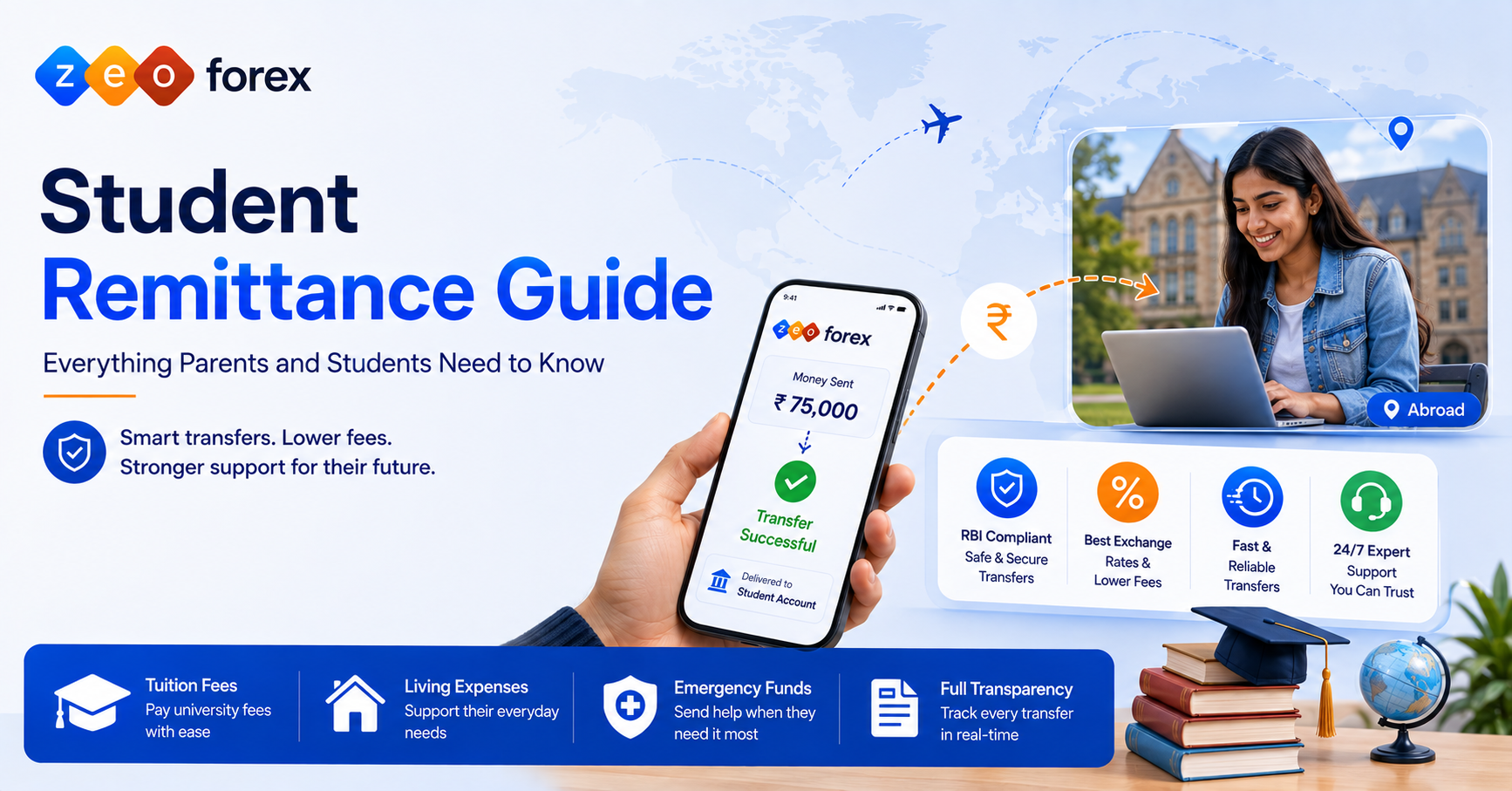
Quick Answer
Student remittance refers to money sent abroad to support a student’s education, whether that is tuition, living expenses or emergency funds. Parents in India typically send this through banks, authorized dealers or online international money transfer platforms, with the right method depending on purpose, amount, cost, speed and current RBI and LRS requirements.
Introduction
Once a child heads abroad for their studies, remittance becomes a regular part of family life. It is not a single transaction but an ongoing relationship with transfers, deadlines, exchange rates and documentation that most families are figuring out for the first time.
At ZeoForex we work with parents and students managing exactly this every intake season, from the first tuition payment to the monthly transfers that follow for years afterward. This guide pulls together everything you need to understand about student remittance from India, whether you are sending your first payment or trying to make your ongoing transfers more efficient.
TL;DR
- Student remittance covers both tuition payments and living expense transfers, and the two are often treated differently
- Common transfer methods include banks, authorized dealers and online international money transfer platforms
- Student remittances fall under RBI’s Liberalised Remittance Scheme, so it is worth verifying current rules before sending
- Costs come from transfer fees, exchange rate margins and sometimes intermediary charges
- A little planning around documentation and timing prevents most common remittance problems
What Is Student Remittance?
Student remittance is the transfer of funds from a sender, usually a parent or guardian, to a student studying in another country, covering education related costs such as tuition, accommodation, food and daily living expenses.
Tuition Remittance vs Living Expense Remittance
These two categories of education remittance often get treated differently by providers and under regulatory frameworks. Tuition remittance goes directly to the university, usually as a larger, less frequent payment tied to semester deadlines. Living expense remittance, sometimes called maintenance remittance, covers ongoing costs and tends to happen more regularly, whether monthly or quarterly. Getting the purpose classification right when initiating a transfer tends to make the whole process smoother.
Why Student Remittance Matters
For most Indian families, student remittance India represents one of the largest recurring financial commitments they will make, often spanning several years across a degree program. Understanding how it works properly can save real money and prevent avoidable stress along the way.
Common Ways to Send a Student Money Transfer
Parents generally choose between a handful of reliable channels, and the right one depends on the purpose, urgency and how often you plan to send money.
| Method | Fees | Exchange Rate | Speed | Best For |
|---|---|---|---|---|
| Bank transfer | Higher | Often weaker | 2 to 5 business days | Large, formal tuition payments |
| Online international money transfer platform | Lower | Competitive | Minutes to 1-2 days | Regular living expense transfers |
| Authorized dealer | Moderate | Competitive | 1 to 3 business days | Guided support for first time senders |
| University payment portal | Varies | Set by provider | Varies | Tuition paid directly to the institution |
Bank Transfers
Sending through your bank feels familiar and secure, often routed through the SWIFT network, though fees and exchange rate margins tend to run higher than digital alternatives.
Online International Money Transfer Platforms
A student international money transfer sent through a dedicated online platform is often faster, more transparent on pricing and easier to track than a traditional bank transfer.
Authorized Dealers
Banks and licensed entities authorized by the RBI can process outward remittances and are a solid option for families who want more guided support through the process.
How Student Remittance Works: Step by Step
Here is the general process most families follow when sending a student forex transfer.
- Determine the amount and purpose, whether tuition, living expenses or an emergency transfer
- Confirm the recipient’s bank details, checking every digit carefully before proceeding
- Choose a transfer provider based on cost, speed and how often you expect to send money
- Compare exchange rates and fees across at least two options
- Check applicable RBI and LRS requirements for the purpose you are declaring
- Complete KYC with your chosen provider
- Initiate the transfer, reviewing all details one final time
- Track the transaction using the reference number provided
- Confirm receipt with the student or the university once the funds arrive
RBI and LRS Considerations for Student Remittance
Outward remittances for education remittance from India, whether for tuition or living expenses, generally fall under the Reserve Bank of India’s Liberalised Remittance Scheme, known as LRS. This framework allows resident individuals to send money abroad for approved purposes, including education, subject to documentation and any applicable limits.
Because RBI, LRS and related tax or TCS requirements can change over time, this guide does not state specific limits or rates. Always verify current requirements directly with the RBI or your authorized dealer before sending a transfer, particularly for larger amounts. This section is general educational information rather than financial, tax or legal advice.
Documents Commonly Needed for Student Remittance
Requirements vary by provider, purpose and amount, but commonly requested documents include:
- PAN card
- Identity proof such as a passport, Aadhaar or voter ID
- Bank account details for both sender and recipient
- A clear statement of the purpose of remittance
- University admission letter or tuition invoice, where applicable
- Any additional supporting documents your provider specifically requests
Since exact requirements can shift over time and between providers, it is worth confirming the current list directly before you begin.
What Does Student Remittance Cost?
A few components make up the real cost of any transfer, and it rarely comes down to just the advertised fee.
- Transfer fees charged directly by the provider
- Exchange rate margin, the gap between the market rate and what actually reaches the recipient
- Intermediary bank charges, which can apply depending on the route the transfer takes
- Recipient bank charges, sometimes deducted by the receiving bank on arrival
Always compare the total amount the student actually receives, not just the fee advertised upfront. Two providers charging identical fees can still leave very different amounts in the recipient’s account once the exchange rate margin is factored in.
How Long Does a Student Remittance Take?
Processing time depends on several factors working together: the destination country, the transfer method chosen, the currency involved, banking hours, weekends and holidays in either country, and whether intermediary banks are involved along the route. Because of these variables, no provider can guarantee an exact processing time for every transfer, so it helps to send funds with some buffer before a hard deadline like a tuition due date.
Monthly vs Periodic Transfers for Living Expenses
Neither approach is universally better, and the right choice depends on your family’s situation.
Monthly transfers tend to offer easier budgeting for both parent and student, and they spread out exposure to exchange rate fluctuations since you are averaging across several transfers rather than betting on a single day’s rate.
Larger periodic transfers, sent quarterly or every few months, can reduce the total number of transaction fees paid, though they concentrate exchange rate risk into fewer, larger transactions.
Many families settle on a hybrid approach, sending a larger transfer to cover a semester’s rent alongside smaller monthly transfers for day to day living costs.
How to Send Student Remittance Safely
A few habits go a long way toward keeping every transfer safe.
- Use only authorized and reputable providers
- Verify recipient details carefully, especially account numbers
- Double check every digit before confirming a transfer
- Keep transaction receipts for every transfer sent
- Use tracking or reference numbers to follow each transfer’s progress
- Avoid unfamiliar or unverified channels, even if they seem cheaper
- Stay alert to unsolicited requests or scams targeting parents of overseas students
Common Mistakes to Avoid With Student Remittance
- Sending money without comparing exchange rates across providers
- Focusing only on the transfer fee while ignoring the exchange rate margin
- Entering incorrect recipient details due to rushing
- Waiting until the last minute for time sensitive payments like tuition
- Not checking documentation requirements before initiating a transfer
- Overlooking applicable RBI and LRS regulations for the declared purpose
- Failing to keep transaction records for future reference
- Sending amounts that are too high or too low without an actual budget behind the number
Checklist Before Sending a Student Remittance
Run through this before initiating any transfer.
- Amount confirmed and matched to an actual need
- Purpose of the transfer clearly identified, tuition or living expenses
- Recipient details verified, including account number
- Exchange rate compared across at least two providers
- Fees reviewed, including any intermediary charges
- Documentation prepared, including PAN and identity proof
- KYC completed with your chosen provider
- Regulatory requirements checked against current RBI and LRS guidance
- Transfer confirmation saved after sending
- Receipt confirmed with the student or university
Frequently Asked Questions
What is student remittance?
It is money sent to a student studying abroad to cover education related costs such as tuition, accommodation and daily living expenses.
How can I send a student money transfer from India?
Through a bank, an authorized dealer or an online international money transfer platform, after completing KYC and confirming the recipient’s account details.
What is the difference between tuition remittance and living expense remittance?
Tuition remittance goes directly to the university as a larger, less frequent payment, while living expense remittance covers ongoing daily costs and tends to happen more regularly.
Is student remittance covered under LRS?
Yes, education related remittances, including both tuition and living expenses, generally fall under RBI’s Liberalised Remittance Scheme, subject to documentation and applicable limits.
What documents are required for student remittance?
Commonly requested documents include PAN, identity proof, bank details for sender and recipient, and purpose specific documents like a tuition invoice or admission letter.
How much does student remittance cost?
Costs include the transfer fee, the exchange rate margin, and sometimes intermediary or recipient bank charges, so compare the total amount received rather than just the fee.
How long does a student remittance take to arrive?
Anywhere from minutes to several business days, depending on the method, destination and verification requirements involved.
Is it better to send living expenses monthly or in larger amounts?
Neither is universally better. Monthly transfers ease budgeting and reduce exchange rate exposure, while larger periodic transfers can reduce overall fees.
Conclusion
Student remittance does not need to feel overwhelming once you understand the basics: choosing the right method for tuition versus living expenses, verifying current RBI and LRS guidance, and comparing the total amount your child actually receives rather than just the advertised fee. Whether you are sending your first tuition payment or your fiftieth monthly transfer, a little planning goes a long way.
At ZeoForex we built our platform to make remittance for students simpler, with transparent pricing and support designed around the needs of families funding overseas education. If you are getting ready to send your next transfer, take a moment to compare your options and confirm current regulatory guidance, then choose a secure and transparent provider like ZeoForex to keep your student’s support arriving on time, every time.