
Quick Answer
The best way to transfer money internationally depends on what matters most to the sender. Online transfer services and regulated forex or remittance providers tend to suit convenience and competitive overall pricing, while bank transfers can suit certain large or institutional payments. Compare the total cost, exchange rate, delivery time, security, limits and documentation requirements before choosing a method.
Introduction
There is no single method that wins every time you need to send money abroad. The right choice depends on how much you are sending, where it is going, why you are sending it, how fast the recipient needs it, the exchange rate on offer, the fees involved, and any regulatory requirements that apply to your situation.
At ZeoForex we get asked constantly which method is “the best,” and the honest answer is always: it depends. This guide walks through the main international money transfer methods, compares them side by side, and helps you figure out which one actually fits your situation. For a broader look at how international transfers work in general, see our complete guide to international money transfer.
What Is the Best Way to Transfer Money Internationally?
There is no single best method for every international transfer. The appropriate option depends on your purpose, transfer amount, destination, urgency, preferred payment method, the exchange rate on offer and the total cost once everything is factored in.
Six factors usually decide the answer for any given transfer: total cost, exchange rate, speed, safety, convenience, and the transfer’s purpose and amount. Once you know where you stand on these, the right method tends to become obvious pretty quickly. The sections below walk through each available method before showing how to weigh them against each other.
What Are the Best Ways to Transfer Money Internationally?
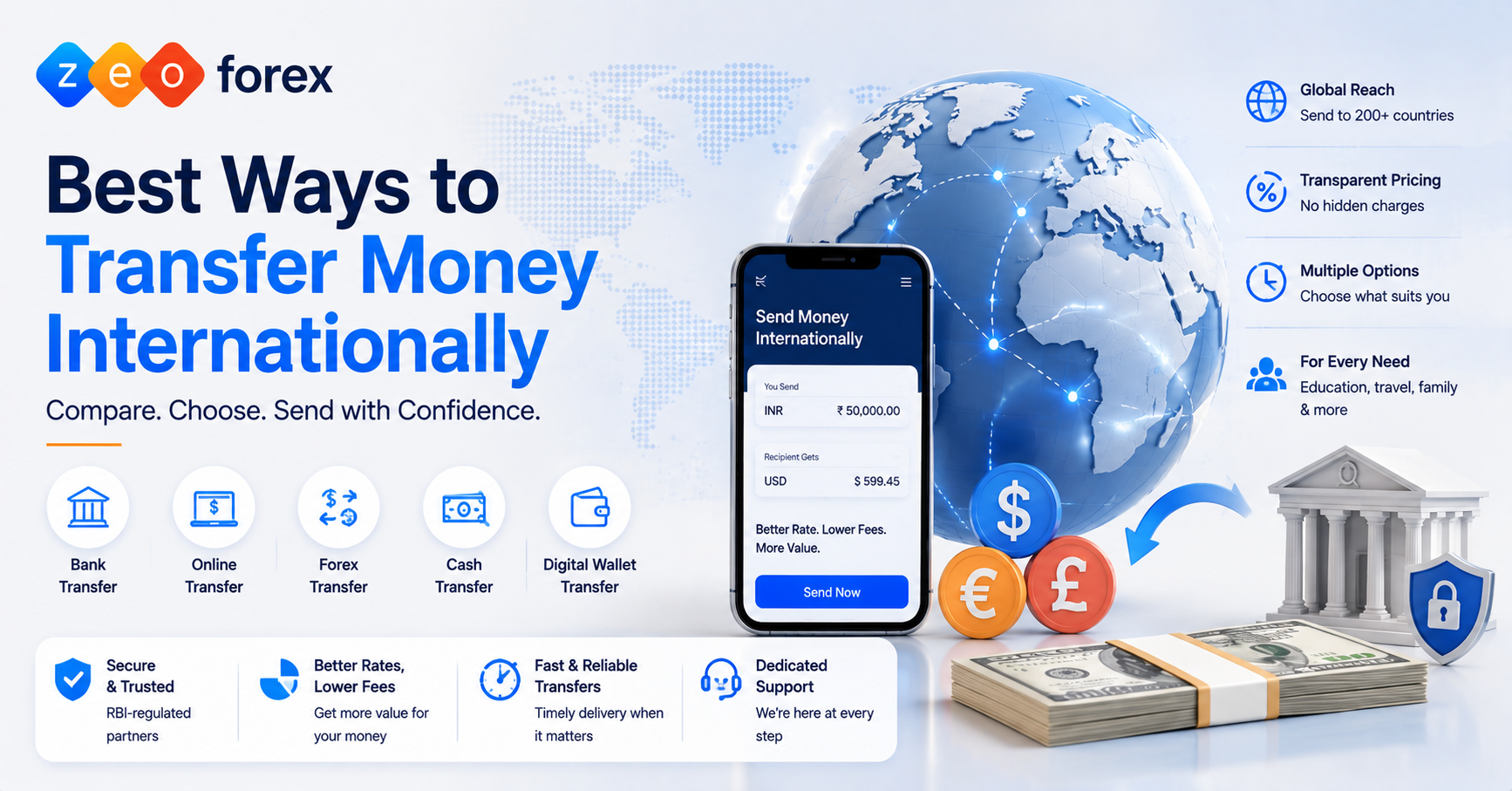
Bank transfers, sometimes called international wire transfers, move money directly from your bank to the recipient’s bank, usually through the SWIFT network. They are familiar and well established, often suitable for large or formal payments, though they commonly carry higher transfer fees, wider FX spreads and sometimes intermediary charges, with processing running slower than digital alternatives.
Online international money transfer platforms let you initiate a transfer digitally, complete KYC online, compare exchange rates before committing, and track progress from your phone or laptop. This tends to suit personal transfers, education payments and recurring transfers where supported, with often competitive pricing, though not universally the cheapest option on every route.
Forex transfers through an authorized dealer convert currency and process outward remittance through a regulated channel. Not every forex business counts as an authorized dealer, so it matters to confirm you are working with a genuinely regulated channel. These transfers typically involve KYC and documentation and tend to suit education payments and other permitted purposes well.
International cash transfer services let a recipient pick up cash at a physical location in some countries, useful for recipients without easy bank access, though availability varies significantly and there are security considerations and fees to weigh against the convenience. For most readers sending money for education or family support, this tends to be a less central option.
International digital wallet transfers are growing in availability, letting funds move between digital wallets where supported. Convenience is a real strength, but availability, supported currencies, transfer limits and recipient requirements vary a lot by country, so it is worth confirming a wallet actually supports your specific route before relying on it.
International Money Transfer Methods Compared
| Transfer Method | Cost | Speed | Convenience | Best For | Main Drawback |
|---|---|---|---|---|---|
| Bank Transfer | Varies, often higher | Varies, often slower | Medium | Large or formal payments | Bank and intermediary charges |
| Online Transfer | Often competitive | Often fast | High | Personal and education transfers | Availability varies by route |
| Forex/Authorized Dealer | Varies | Varies | Medium to High | Currency conversion, outward remittance | Documentation may apply |
| Cash Transfer | Varies | Varies | Medium | Certain cash pickup needs | Availability and security considerations |
| Digital Wallet | Varies | Often fast where supported | High | Supported digital transfers | Limited availability and currencies |
What Is the Cheapest Way to Transfer Money Internationally?
The cheapest method cannot be identified by looking at the advertised transfer fee alone. The actual cost depends on both the fee and the exchange rate offered, along with any additional charges layered on top.
Total Transfer Cost = Transfer Fee + FX Markup or Spread + Other Applicable Charges
This total can include fixed transfer fees, percentage based fees, FX markup, the exchange rate spread, correspondent or intermediary charges, recipient bank charges, and any applicable taxes or regulatory charges depending on the route. A transfer with a low visible fee can still cost more overall if the provider applies a less favorable exchange rate behind the scenes. For a deeper breakdown of this, see our guide on the cheapest way to send money abroad.
What Is the Fastest Way to Transfer Money Internationally?
Transfer speed depends on the method, destination, currency, payment route, banking hours, compliance checks and the recipient’s institution. A same day transfer on one route might take several days on another, purely based on these variables.
Weekends and holidays in either country can add delay, as can routine compliance review or an unfamiliar intermediary bank in the payment chain. It is worth being clear that fast initiation does not guarantee immediate recipient availability. The transfer can leave your account quickly and still take time to actually land. For more detail, see our guide on how long an international transfer takes.
What Is the Safest Way to Transfer Money Internationally?
The safest approach is to use legitimate, regulated channels with appropriate identity verification, transaction security and transparent transfer information. Look for regulatory authorization, proper KYC processes, transaction monitoring, strong authentication, fraud prevention measures, solid data security, a way to verify recipient details, clear tracking, responsive customer support, and transparent terms you can actually read and understand. A regulated provider that handles KYC properly and gives you tracking is generally the safer bet over an unregulated option promising a slightly better rate.
How Exchange Rates Affect International Transfer Costs
Two rates matter here, and the gap between them explains a lot about what your recipient actually receives. The reference or mid-market rate is the benchmark rate used to understand currency conversion generally, the one you would see quoted in the news. The provider exchange rate is what is actually offered to you as the customer, and it is usually a bit different.
The gap between these two, known as the FX markup or spread, directly affects how much currency your recipient ends up with. If your provider offers a less favorable rate than the reference, the difference quietly reduces what actually arrives, even if the advertised transfer fee looked low. Always compare how much the recipient actually receives, not just the transfer fee on its own.
What Fees Should You Compare?
| Cost | What It Means | Why It Matters |
|---|---|---|
| Transfer fee | The direct charge for processing the transfer | The most visible cost |
| FX markup | The difference applied during currency conversion | Can materially affect the recipient’s amount |
| Exchange rate spread | The gap between the reference and offered rate | Often overlooked entirely |
| Intermediary fee | Charges from intermediary institutions along the route | May add to total cost |
| Recipient bank fee | A possible charge from the receiving bank | Can reduce the final amount received |
| Applicable taxes or regulatory charges | Government or tax related charges where applicable | Can affect total outlay |
For a full breakdown of what these charges look like in practice, see our guide on international money transfer charges explained.
Best Way to Send Money Abroad from India
For Indian residents, the appropriate outward remittance method depends on the purpose, amount, destination, applicable foreign exchange rules, documentation and the authorized channel used.
This generally means working within the RBI framework and the Liberalised Remittance Scheme, completing KYC, and having PAN and other documentation ready depending on the purpose of the remittance. RBI’s published LRS framework has historically described a limit for resident individuals for permitted transactions, though the exact figure and applicable tax treatment can change over time. Always verify current RBI, LRS, KYC and tax requirements directly through official sources before initiating a transfer, since regulations can be amended. For a full step by step walkthrough, see our guide on how to send money abroad from India.
Best Transfer Method for Different Situations
For tuition fees, prioritize reliable delivery, correct beneficiary details, a clear payment reference, proof of payment, proper documentation, a competitive exchange rate and sufficient transfer limits. See our guide on paying university tuition fees abroad for more.
For student living expenses, prioritize convenience for recurring transfers, competitive exchange rates, appropriate transfer limits and consistent delivery reliability. See our guide on how parents can send living expenses to students overseas for more.
For supporting family abroad, prioritize frequency, cost, convenience and how easily your recipient can actually access the funds once they arrive.
For travel money, prioritize speed, convenience, currency availability, and methods that work well for smaller transfer amounts.
For large international transfers, prioritize authorized channels, proper documentation, applicable limits, compliance requirements, the exchange rate offered and the total cost once everything is added up.
For recurring international transfers, prioritize the convenience of repeat transfers, consistent exchange rates, predictable fees, accessible transaction history and how easily you can initiate the next transfer.
How to Choose the Right International Money Transfer Method
Work through this before committing to a provider:
- Define the transfer purpose
- Determine the amount
- Identify the destination and currency
- Decide how quickly the recipient actually needs the funds
- Compare exchange rates across providers
- Compare total costs, not just advertised fees
- Check transfer limits
- Review KYC and documentation requirements
- Confirm recipient details carefully
- Review tracking and cancellation or refund policies
Common Mistakes to Avoid When Choosing a Transfer Method
Choosing a provider based only on the advertised fee, ignoring the FX markup hidden in the exchange rate, and not checking how much the recipient actually receives are some of the most common and costly mistakes. Others include using unauthorized channels to save a little money, entering incorrect beneficiary details, ignoring KYC or documentation requirements, assuming every transfer is instant, and not reading the cancellation or refund conditions before sending. For more on this, see our guide on common mistakes while sending money overseas.
How ZeoForex Makes International Money Transfers Easier
Manual, fragmented transfer processes make it hard to compare rates, complete documentation and manage overseas payments efficiently, especially when sending money regularly for tuition or living expenses.
ZeoForex is built around a fully online remittance workflow: confirm your transfer requirement, complete KYC and documentation, get a transparent exchange rate, initiate the transfer, and track it through to completion. The platform is designed specifically around education related remittances and student living expenses, alongside everyday international payments, with a focus on digital convenience from start to finish.
Explore ZeoForex for simpler international money transfers.
Key Takeaways
There is no single best international money transfer method that fits every situation. Compare total cost, not just the advertised transfer fee, since exchange rate differences can materially affect the final amount your recipient receives. Delivery speed varies by route and provider, so always use legitimate and appropriately regulated channels. The right option ultimately depends on your purpose, amount, destination and urgency, and Indian users specifically should check current RBI, LRS, KYC and applicable tax requirements before transferring funds.
Ready to simplify your international remittance process? Explore ZeoForex and see how online remittance can make overseas payments more convenient.
Frequently Asked Questions
What is the best way to transfer money internationally?
It depends on your priorities. Online transfer services and authorized forex providers often suit convenience and competitive pricing, while bank transfers can suit certain large, formal payments.
What is the cheapest way to transfer money internationally?
Compare the total cost, including the transfer fee and the exchange rate margin, rather than just the advertised fee alone.
What is the fastest way to transfer money internationally?
Speed depends on the method, destination, currency and compliance checks involved, so it varies by route rather than having one universally fastest option.
What is the safest way to transfer money internationally?
Using a regulated provider with proper KYC, transaction monitoring and clear tracking is generally the safer choice over unregulated alternatives.
How do exchange rates affect international transfers?
The gap between the reference rate and the rate your provider actually offers can meaningfully reduce how much your recipient receives, even with a low advertised fee.
What is the best way to send money abroad from India?
It depends on the purpose and amount, and generally involves working through RBI’s LRS framework with proper KYC and documentation.