
Quick Answer
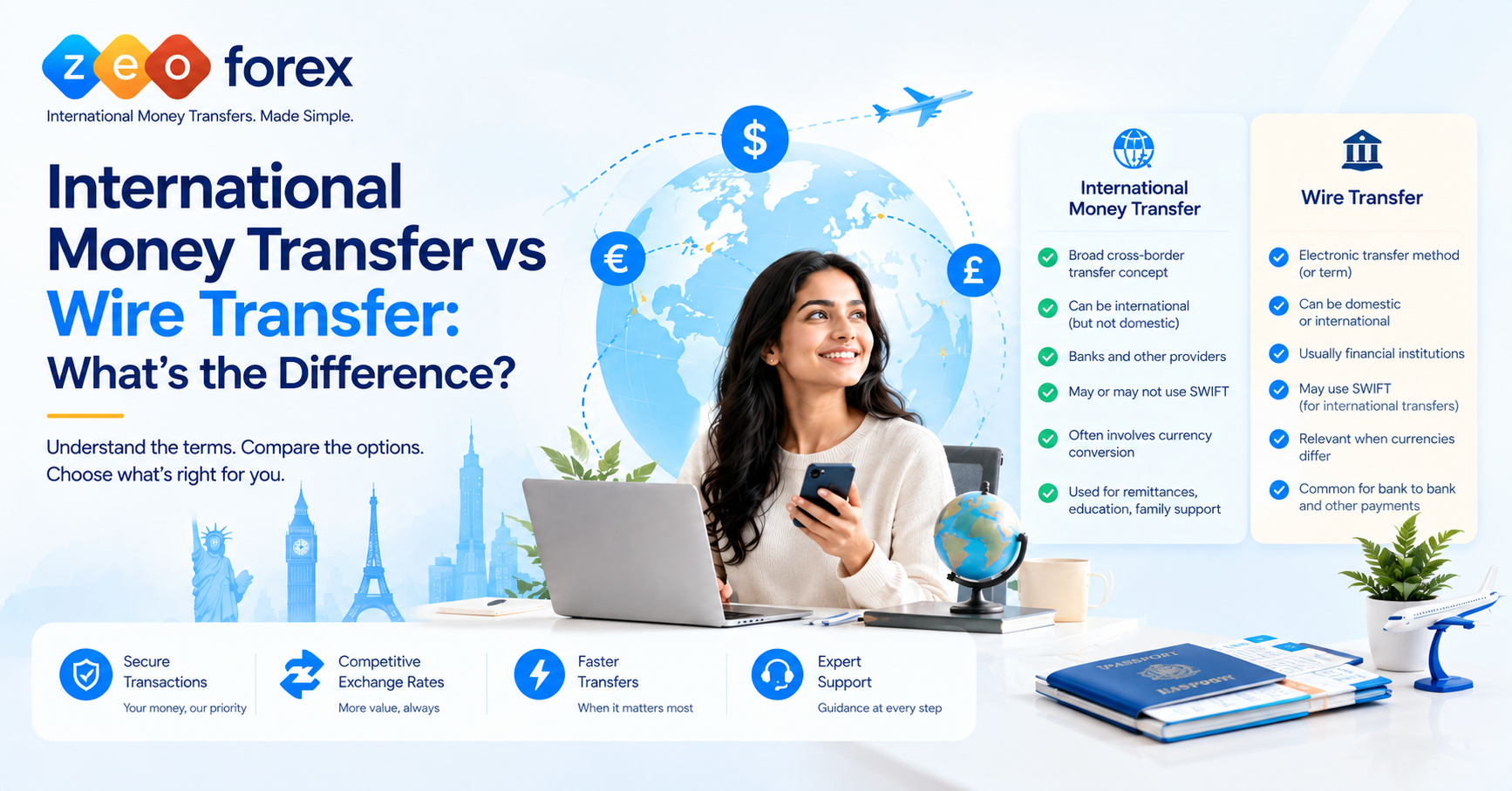
An international money transfer is a broad term for moving money across countries, while a wire transfer describes a method of electronically transferring funds between financial institutions. An international wire transfer is therefore one type of cross-border transfer. The terms can overlap, but they are not universally interchangeable, and usage varies by provider and jurisdiction.
Introduction
If you have ever tried to send money abroad, you have probably run into a confusing pile of terms: international money transfer, wire transfer, international wire, bank transfer, SWIFT transfer, remittance. It is genuinely hard to tell whether these describe different things or just different names for the same transaction.
The short answer is that they overlap but are not identical. At ZeoForex we help people navigate this every day, usually for education payments, medical expenses or family support. This guide sorts out what each term actually means, where the differences matter and what to compare before you send money overseas.
What Is an International Money Transfer?
An international money transfer is the movement of funds from a sender in one country to a recipient in another. Currency conversion may or may not happen along the way depending on the currencies involved.
The key thing to understand is that this phrase describes the overall transaction or service rather than one specific technical rail. Banks, specialist money transfer providers and other payment providers can all facilitate an international transfer, and the actual route the money takes varies. The CFPB notes that remittance transfers are commonly referred to as international wires, international money transfers or remittances depending on context, which tells you something about how loosely these terms get used in practice.
What Is a Wire Transfer?
A wire transfer is an electronic transfer of funds that commonly involves financial institutions communicating payment instructions to each other. It is worth being precise here: a wire transfer can be domestic or cross-border. It is not automatically international.
RBI’s framework explicitly distinguishes between domestic wire transfers and cross-border transfers, defining a cross-border transfer as a wire transfer where the originating and beneficiary financial institutions sit in different countries. So when someone says “wire transfer,” the international element is not built into the term itself. It depends on where the two institutions are.
Terminology also differs between institutions and markets, which is a big part of why this whole topic gets confusing.
International Money Transfer vs Wire Transfer: Key Differences
The main distinction is scope and terminology. International money transfer describes the broader act or service of moving money across borders, while wire transfer commonly refers to a particular electronic transfer method. An international wire transfer is a cross-border wire transfer, but not every international money transfer needs to be described as a wire transfer.
| Factor | International Money Transfer | Wire Transfer |
|---|---|---|
| Scope | Broad cross-border transfer concept | Electronic transfer method or term |
| Can be domestic | No, in the international sense | Yes |
| Can be international | Yes | Yes |
| Provider | Banks and other transfer or payment providers | Commonly financial institutions, depending on context |
| Bank involvement | Depends on route | Commonly involved |
| SWIFT | May or may not be involved | May be involved in international banking transfers |
| Currency conversion | Often relevant | Relevant when currencies differ |
| Fees | Provider and route dependent | Bank, network and route dependent |
| Speed | Varies | Varies |
| Typical use | Remittances, education, family support | Bank to bank and other electronic payments |
| Key distinction | Describes the broader transaction or service | Describes a transfer method or term |
Are International Money Transfers and Wire Transfers the Same?
Not always. The terms overlap, but their scope is different.
They overlap because both describe the electronic movement of money, international wire transfers genuinely are international money transfers in the broad sense, and providers often use different terminology for what is functionally a similar customer-facing service. They are not perfect synonyms because wire transfers can be entirely domestic, international money transfer describes the cross-border objective more broadly, and different providers offer different delivery mechanisms under similar-sounding names.
Take a practical example. A parent in India paying an overseas university sends money through a provider or bank, which routes it through an international payment path to the university’s bank. Whether that gets called a “wire,” an “international transfer” or some provider-specific name often depends entirely on which institution is handling it. The underlying transaction is what you should be evaluating, not the label.
What Is an International Wire Transfer?
An international wire transfer is a wire transfer involving financial institutions in different countries. It typically requires recipient bank details, may involve intermediary or correspondent institutions along the route, and may include currency conversion. Applicable compliance requirements depend on the specific transaction and jurisdictions involved.
One important distinction: an international wire transfer is a type of wire transfer. It is not the same thing as SWIFT, which is a common point of confusion worth clearing up properly.
How Does an International Wire Transfer Work?
The general flow looks like this:
Sender → Sending bank or payment provider → Intermediary or correspondent banks where applicable → Recipient bank → Recipient
- The sender provides payment instructions to their institution
- The sending institution verifies and processes the transaction
- Payment instructions are transmitted through the applicable network
- Intermediary institutions may be involved depending on the route
- The receiving institution processes the payment
- The recipient’s account is credited subject to applicable checks
SWIFT explains that a bank may send a payment message through its network to the recipient bank, after which the recipient bank processes the payment. Not every transfer follows an identical route, and the number of intermediary institutions involved varies considerably by currency pair and destination.
SWIFT vs Wire Transfer vs International Money Transfer
This is where most of the confusion lives, so it is worth laying out clearly.
| Term | What it describes | Role |
|---|---|---|
| International money transfer | Broad cross-border money movement or service | The overall transaction |
| Wire transfer | Electronic transfer method or term | The transfer mechanism |
| International wire transfer | Cross-border wire transfer | A specific type of wire |
| SWIFT | Financial messaging network | Communication layer used by institutions |
The critical point: SWIFT does not move money. SWIFT provides messaging infrastructure through which participating financial institutions communicate payment instructions and related information securely. The actual funds move through the banking relationships between those institutions. SWIFT’s own materials describe the network as a secure financial messaging system rather than a mechanism that transfers funds directly.
So “SWIFT transfer” as people commonly use it is shorthand for a bank transfer where SWIFT handled the messaging. It is not a separate category of money movement.
Fees and Exchange Rates
The cost of an international transfer includes more than the advertised transfer fee. Transfer fees can include a sending fee from your provider, a receiving fee where applicable, and intermediary or correspondent charges from banks along the route.
Exchange rate cost is the one most people miss. The rate your provider quotes is not necessarily the underlying reference rate you see quoted in the news, and the gap between them, sometimes called the FX spread or markup, directly reduces the amount that arrives.
A useful comparison framework: total transfer cost = transfer fee + FX cost or spread + possible intermediary and receiving charges. Treat that as a way to compare providers rather than a universal billing formula, since exactly which charges apply depends on the route. The practical metric worth focusing on is the final amount your recipient actually receives.
How Long Do They Take?
There is no universal speed for either category. Processing time depends on the currency, the sending institution, the receiving institution, the destination, the payment route, intermediary banks, daily cut-off times, weekends and holidays, compliance checks and the recipient bank’s own processing.
It is also worth separating two different things: how long the transfer takes to process, and how long until the funds are actually available to the recipient. Those are not always the same, and the second one is what usually matters to the person waiting on the money.
What Information Is Needed for an International Wire Transfer?
Commonly requested details include:
- Sender details
- Recipient name and address where required
- Recipient account number
- Bank name and address where required
- IBAN where applicable
- SWIFT or BIC code where applicable
- Transfer amount and currency
- Purpose of payment where required
- Supporting documentation where required
For transfers from India specifically, you will typically also need PAN and KYC details, a declared purpose of remittance, Form A2 where applicable and any supporting documentation tied to that purpose.
International Money Transfer vs Wire Transfer From India
For residents sending money from India, the practical comparison should focus on the payment route, provider, purpose of remittance, applicable foreign exchange rules, KYC, documentation, fees and exchange rate rather than on which label the provider uses.
Outward remittance simply refers to money being sent out of India to a recipient abroad, operating within a defined regulatory framework rather than as a free-for-all. LRS, the Liberalised Remittance Scheme, allows eligible resident individuals to remit funds abroad for permitted current or capital account transactions within an annual framework, subject to purpose-specific rules and authorised channels. Because RBI directions get updated periodically, always verify the current LRS limit, applicable rules and tax treatment directly with RBI or your authorised dealer before sending rather than relying on figures quoted in general articles like this one.
KYC and documentation requirements apply because authorised entities must run applicable KYC and AML checks on LRS transactions. Common India use cases include education and tuition payments, student living expenses, medical expenses, travel and family support, among other permitted purposes.
Which Transfer Method Fits Different Situations?
Rather than asking which method is universally best, it helps to think about what actually matters for your specific situation.
| Situation | What to compare |
|---|---|
| University tuition | Recipient instructions, currency, documentation, amount, delivery reliability |
| Student living expenses | Frequency, convenience, total cost, recipient access |
| Medical payment | Timing, documentation, recipient requirements |
| Family support | Frequency, convenience, exchange rate, recipient access |
| Travel | Timing, currency, amount, convenience |
| Business payment | Purpose documentation, beneficiary requirements, compliance, settlement |
How to Compare an International Money Transfer and Wire Transfer
Before sending, compare the total cost, the exchange rate offered, the amount your recipient actually receives, transfer speed, recipient requirements, currency availability, transfer limits, documentation requirements, compliance obligations, tracking and customer support.
The key takeaway: compare the actual transfer process and total cost, not just the name the provider uses for the service. Two providers can call the same thing by different names and still deliver very different amounts to your recipient.
How ZeoForex Helps With International Money Transfers
ZeoForex offers international money transfer and forex services for India to overseas transfers, with a focus on education, medical and travel related remittances. The process runs online, with transparent exchange rates and RBI-licensed partners handling the regulated side, and LRS based remittance where applicable.
Sending money abroad from India? Explore ZeoForex to compare your international transfer options and understand the applicable process before you send.
Key Takeaways
- International money transfer is the broader concept covering any cross-border movement of funds
- Wire transfer is a transfer method or term with both domestic and international uses
- An international wire transfer is specifically a cross-border wire transfer
- SWIFT is financial messaging infrastructure, not simply another name for the transfer itself
- Fees, exchange rates, speed, recipient requirements and applicable regulations matter far more than terminology alone
Frequently Asked Questions
Is an international money transfer the same as a wire transfer?
Not always. They overlap, but international money transfer is a broader term while wire transfer describes a specific electronic transfer method that can also be domestic.
Is a wire transfer always international?
No. Wire transfers can be domestic or cross-border. Only those involving institutions in different countries are international wire transfers.
Is SWIFT the same as a wire transfer?
No. SWIFT is a financial messaging network that institutions use to communicate payment instructions. It is not the transfer itself.
How does the exchange rate affect an international transfer?
The gap between the reference rate and the rate your provider offers directly reduces the amount your recipient receives, sometimes by more than the transfer fee itself.
Can I send an international wire transfer from India?
Yes, through authorised channels, subject to applicable RBI and LRS requirements, KYC and purpose-specific documentation.