
Quick Answer: What Charges Apply to International Money Transfers?
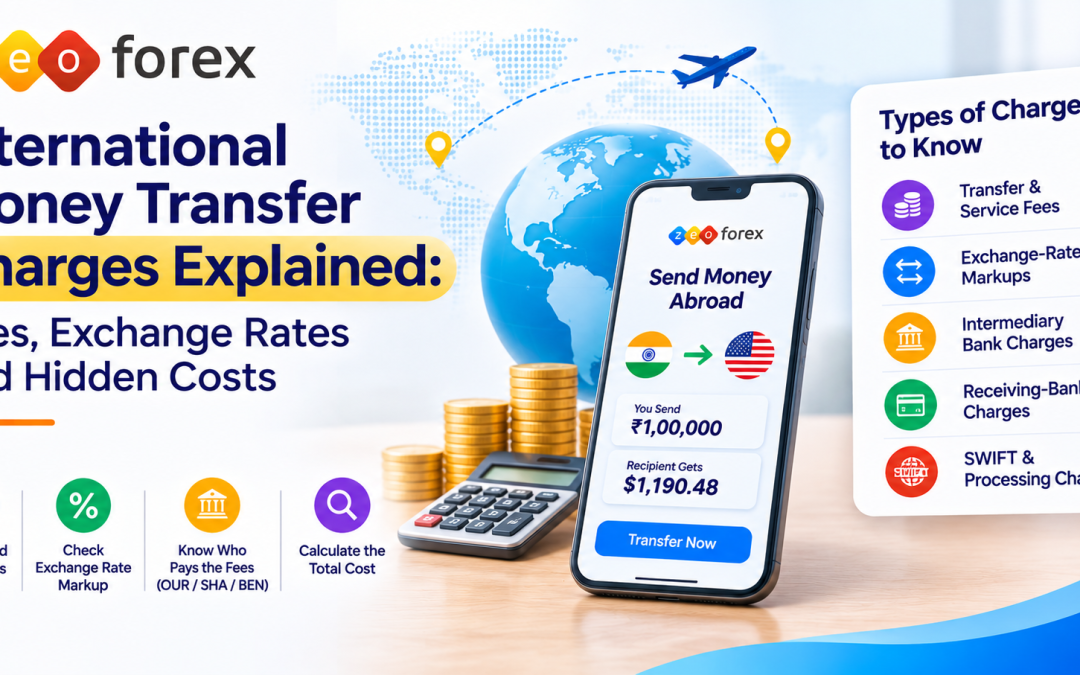
International money transfer charges can include provider transfer fees, exchange-rate markups, intermediary bank fees, receiving-bank charges and applicable taxes. Not every charge applies to every transfer. The total depends on the provider, payment route, currency, amount and fee arrangement. Always check what the sender pays and what the recipient will actually receive.
Introduction
A parent gets a quote to send a tuition payment to a university abroad. The transfer fee looks small, so it seems like a good deal. But the final cost also depends on the exchange rate and on any bank charges taken along the way.
So the real question is simple. How much will you pay and how much will the recipient actually receive? This guide breaks it down. For a wider overview, see our international money transfer guide.
What Are International Money Transfer Charges?
International money transfer charges are the costs of arranging, converting, processing or receiving a cross-border payment. They don't always show up in the same place:
- Some appear as explicit fees on your quote or invoice.
- Some are built into the exchange rate you're offered.
- Some are deducted along the payment route by intermediary or receiving banks.
That's why the advertised transfer fee is not always the full cost of an international money transfer. It helps to think about three separate numbers:
| Term | What it means |
|---|---|
| Transfer cost | Everything you pay for the transfer, visible or embedded |
| Total amount debited | What actually leaves your account |
| Amount received | What lands in the recipient's account after any deductions |
What Types of Charges Apply to International Transfers?
Here are the main international transfer charges you're likely to come across.
1. Transfer and Service Fees
This is the fee most people notice first. It might be a fixed amount, a percentage of the transfer or a mix of both. It can also change depending on the payment method, the amount you send and the currency.
Be careful with "zero fee" offers. A provider can skip the transfer fee and still make money through a less favourable exchange rate or other charges. A low fee is only good news if the rest of the quote holds up too.
2. Exchange-Rate Markups and Currency Conversion Charges
When you convert INR to another currency, three rates matter:
- Reference rate: A benchmark such as the mid-market rate.
- Customer rate: The rate you're actually offered.
- Exchange rate margin: The gap between the two, often called the exchange rate markup or foreign exchange markup fee.
A less favourable rate means less foreign currency for the same rupee amount. Here's a hypothetical example for converting ₹1,00,000 to USD:
| Rate offered | USD received | |
|---|---|---|
| Quote A | ₹84.00 per USD | $1,190.48 |
| Quote B | ₹85.00 per USD | $1,176.47 |
Illustrative figures only, not live rates.
Currency conversion charges may be built into the rate or listed separately. Just don't count the same markup twice. Our guide to exchange rates and transfer charges explains this in more depth.
3. Intermediary and Correspondent Bank Charges
Some cross-border bank payments don't travel directly from your bank to the recipient's bank. They pass through one or more intermediary or correspondent banks along the way.
Each of these banks may deduct a fee, which reduces the amount credited at the end. The exact route isn't always known in advance, so intermediary bank charges are often hard to predict precisely.
4. Receiving-Bank and Beneficiary Charges
The beneficiary's bank may also charge a fee for receiving an international transfer. Whether it does depends on its own tariff and the fee arrangement you chose.
This is why the amount arriving at the receiving bank isn't always the same as the final net amount credited to the beneficiary.
5. SWIFT and Payment Processing Charges
SWIFT is a financial messaging network that banks and other institutions use to send payment instructions. It isn't a transfer service that charges every sender directly.
Banks may still label some costs as wire, SWIFT or processing fees. These are often bundled together, so check your bank's fee schedule before assuming they're separate charges. Learn more about how SWIFT transfers work or compare an international transfer vs wire transfer.
Who Pays International Transfer Fees? Understanding OUR, SHA and BEN
When you send a bank transfer, you can often choose who bears the charges. These are the three common OUR SHA BEN charges options:
| Instruction | General meaning | Possible effect on the recipient |
|---|---|---|
| OUR | The sender covers applicable charges | Aims to minimise deductions, subject to route and bank terms |
| SHA | Sender and beneficiary each bear different charges | Some deductions may reduce the amount received |
| BEN | The beneficiary bears applicable charges | Charges may come out of the amount transferred |
A couple of things to keep in mind. SHA doesn't mean an equal 50/50 split. It means the sender pays their bank's charges and the recipient bears charges further down the line. OUR also doesn't guarantee the exact amount will arrive every time, because some deductions can still happen depending on the route.
You may also see the newer ISO 20022 terms DEBT, SHAR and CRED. These broadly match OUR, SHA and BEN.
How to Calculate the Total Cost of an International Money Transfer
Here's how to calculate international transfer fees step by step.
Step 1. Identify the Amount Being Converted
Start with the principal: the amount that will actually be converted. Keep any fees paid separately out of this figure.
Step 2. Apply the Provider's Exchange Rate
Divide the principal by the provider's quoted rate. This gives you the foreign currency amount before any deductions along the route.
Step 3. Add Explicit Fees and Taxes
Add any separately charged fees and applicable taxes to work out your total debit. If the markup is already in the rate, don't add it again.
Step 4. Estimate the Net Recipient Amount
Subtract any known intermediary or receiving-bank charges. If you don't know them yet, treat the final figure as an estimate.
Illustrative Calculation
All values below are hypothetical. They are not live exchange rates or ZeoForex prices.
| Item | Amount |
|---|---|
| Conversion principal | ₹1,00,000 |
| Quoted exchange rate | ₹84.00 per USD |
| Separate transfer fee | ₹500 |
| Foreign currency before deductions | $1,190.48 |
| Downstream bank deduction | $20.00 |
| Sender debit (before taxes) | ₹1,00,500 |
| Estimated recipient amount | $1,170.48 |
This assumes the fee is paid separately, the full principal is converted and the quoted rate already includes any markup. Taxes are excluded.
There's an important difference between two questions here:
- Sender-budget question: How much will I be debited to convert a set amount?
- Recipient-target question: How much do I need to send so the recipient gets an exact net amount?
They aren't interchangeable. When a university needs a precise tuition amount, the second question is the one that matters. That's the real total cost of sending money abroad.
International Money Transfer Charges from India
Outward remittance charges in India can include a few extra layers on top of bank and conversion costs.
Bank Charges and Foreign Exchange Conversion
Sending money abroad from India may involve provider or bank charges, foreign exchange conversion costs and other transaction-specific expenses. Ask for an itemised quote so you can see each one. Our guide to sending money abroad from India covers the full process.
GST on Applicable Services
GST on foreign exchange transactions is a separate tax from the provider's service fee. How it's calculated depends on the service and the current rules, so check the provider's invoice and official GST guidance for the exact amount.
TCS on Foreign Remittances
TCS on foreign remittance is a tax collection mechanism, not a remittance fee. According to Income Tax Department guidance, it applies to eligible remittances under the Liberalised Remittance Scheme above an annual threshold of ₹10 lakh, with an exemption for remittances funded by an education loan, subject to conditions. Rates and exemptions depend on the transaction and the law in force at the time, so confirm the current position before you send.
LRS and Authorised Dealers
The RBI's Liberalised Remittance Scheme sets the framework for outward remittances by eligible resident individuals. Remittances go through authorised dealers such as banks. The LRS framework covers individuals, not companies, which follow different rules.
How International Transfer Charges Affect Overseas Tuition Payments
Tuition fee transfer charges from India deserve special attention because universities usually expect an exact amount.
- Check the invoiced currency and amount. The university's required net amount matters more than a low headline fee.
- Watch for short payments. Intermediary or receiving-bank deductions can leave the payment below the invoice.
- Follow official instructions. Confirm the university's payment details and include the correct student reference.
- Treat it differently from a personal transfer. A tuition invoice has a fixed target amount and often a deadline.
- Allow time for allocation. Payment confirmation and the university matching funds to the student's account can happen at different times.
Hypothetical scenario: A university requires USD 5,000. The payment is sent on SHA terms and an intermediary bank deducts $25, so only $4,975 arrives. The student now has a balance to clear. Checking the payment route and fee arrangement before sending helps avoid this, although not every transfer will face such deductions. For more, read our guide to paying overseas tuition fees and check typical international transfer processing times.
How to Compare International Money Transfer Quotations
Hidden charges in an international money transfer usually show up when quotes aren't compared fairly. Compare each option on the same basis: the same sending amount, receiving currency, payment route where possible and time of quote.
Use this checklist:
- Confirm the sending and receiving currencies
- Compare the quoted exchange rates
- Check explicit provider and bank fees
- Ask about intermediary or receiving-bank deductions
- Confirm applicable taxes separately
- Review OUR, SHA or BEN options where available
- Compare the estimated net recipient amount
- Confirm how long the quote is valid and any rate-lock conditions
When weighing international transfer fees vs exchange rates, the estimated net recipient amount is usually the fairest single number to compare. Our guide to the cheapest way to send money abroad goes further, and you can avoid other slip-ups with our list of international money transfer mistakes.
How ZeoForex Supports Education-Related International Remittances
ZeoForex is an international remittance solution for education consultants, immigration consultants and businesses that coordinate overseas education payments.
It helps teams understand quoted exchange rates and applicable charges and get education payments right, from tuition invoices to payment details. If you manage overseas education payments for students and families, explore ZeoForex for education-related international transfers.
Frequently Asked Questions About International Money Transfer Charges
What charges apply to an international money transfer?
Charges can include provider fees, exchange-rate markups, intermediary and receiving-bank deductions and applicable taxes. Not all of them apply to every transfer.
Are international transfer fees and exchange-rate markups the same?
No. A transfer fee is usually charged separately. An exchange-rate markup is built into the rate you're offered, so it's less visible but still adds to your cost.
What are intermediary bank charges?
These are fees deducted by banks that sit between the sending and receiving banks on some payment routes. They don't apply to every transfer.
Who pays international transfer charges?
It depends on the arrangement. With OUR the sender covers charges, with SHA they're split between sender and recipient and with BEN the recipient bears them.
How can I calculate the total cost of sending money abroad?
Take the principal, apply the provider's rate, add separate fees and taxes, then subtract any known bank deductions to estimate what the recipient gets.
Does TCS apply when sending money abroad from India?
It can. Whether it applies depends on current law, the remitter, the amount and the payment purpose. Check the latest Income Tax Department guidance.
Conclusion: Compare the Total Cost Before Sending Money Abroad
International money transfer charges include both visible fees and less obvious exchange-rate differences. Before you send, compare quotes using two numbers: what you'll be debited and what the recipient should receive. For overseas education payments, ZeoForex can help you plan transfers with a clearer view of the full cost.