
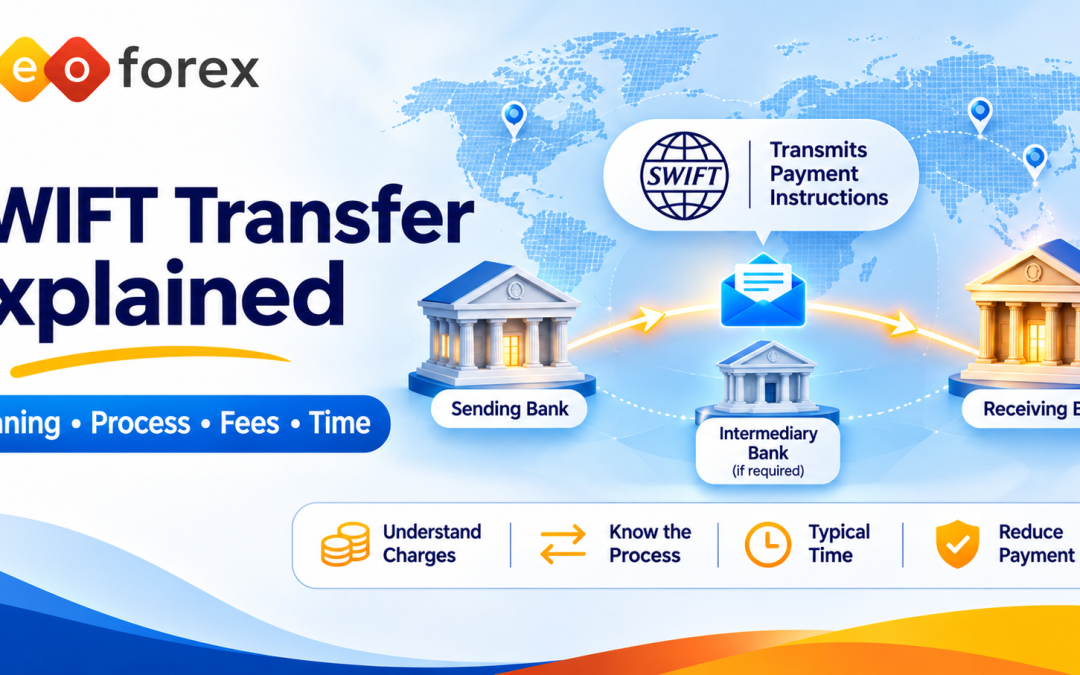
Quick Answer: What Is a SWIFT Transfer?
A SWIFT transfer is an international bank payment that uses the SWIFT financial messaging network to send payment instructions between banks. Banks may use correspondent banking arrangements to complete the payment. SWIFT itself does not move or settle customer funds. The time taken and total charges depend on the banks, payment route, currency and checks involved.
Introduction
Your overseas university's payment instructions list a beneficiary name, an account number, a reference and a mysterious SWIFT code. What do you do with all of that?
This guide explains how a SWIFT transfer works, what it costs, how long it takes and how to track it. Not every international payment uses SWIFT, but many bank transfers do. For the bigger picture, see our international money transfer guide.
What Is a SWIFT Transfer?
SWIFT stands for the Society for Worldwide Interbank Financial Telecommunication. It's a global network that banks and other financial institutions use to send secure, standardised financial messages to each other.
A "SWIFT transfer" or "SWIFT payment" usually means an international bank payment whose instructions travel through this network. SWIFT is not a bank or a payment app.
Does SWIFT Actually Transfer Money?
No. This is the most common misunderstanding about the SWIFT transfer meaning. SWIFT carries the instructions and information about a payment. The actual movement and settlement of money happens through the banks involved and their banking arrangements. SWIFT doesn't hold customer funds or keep customer accounts.
SWIFT is the secure messenger and the banks move the money. Read more about the wider process in our guide on how to send money abroad.
How Does a SWIFT Transfer Work?
Here's the typical journey of a SWIFT international transfer in five steps.
Step 1. The Sender Initiates the Payment
You instruct your bank or authorised payment provider to send money. You provide the amount, currency, beneficiary details and the purpose of the payment.
Example: A parent sets up a payment to an overseas university using the bank details from the university's official payment instructions.
Step 2. The Sending Bank Processes the Instructions
Your bank checks your account, validates the details and runs any required compliance checks. If you're paying in a different currency, it also converts the money at its quoted exchange rate.
Step 3. SWIFT Messaging Communicates Payment Instructions
Your bank sends a standardised message through the SWIFT network. The message identifies the banks involved, the beneficiary and the payment details so everyone in the chain understands what to do.
Step 4. Correspondent or Intermediary Banks May Be Involved
If your bank doesn't have a direct relationship with the recipient's bank, it may route the payment through one or more correspondent banks. These intermediaries help settle the payment between institutions. Their involvement can affect both fees and timing. Not every transfer needs them, though.
Step 5. The Beneficiary Bank Receives and Credits the Funds
The receiving bank processes the incoming payment. It may carry out its own checks before crediting the money to the recipient's account.
What Details Are Required for a SWIFT Transfer?
Getting the details right is the easiest way to avoid delays. Here are the typical SWIFT transfer requirements:
- Beneficiary's full name
- Beneficiary account number or IBAN, where applicable
- Beneficiary bank name
- Bank address, where required
- Correct SWIFT/BIC code
- Transfer amount and currency
- Payment purpose
- Intermediary bank details, if requested
- Supporting documents, where applicable
- University or invoice reference, where required
What Happens If Bank Details Are Incorrect?
Wrong beneficiary bank details can cause delays, rejections, returns or investigations, often with extra charges.
You usually can't edit a payment once it's sent, so double-check everything against official instructions before you confirm. See our list of international transfer mistakes for more tips.
What Is a SWIFT/BIC Code?
A SWIFT code is also called a BIC, which stands for Business Identifier Code. It identifies a financial institution or other business taking part in international payments. Under the ISO 9362 standard, a BIC has eight characters, with an optional three-character branch code that makes it eleven characters long.
Always get the code from official bank information or the recipient's payment instructions. Never guess or rely on an unofficial website.
SWIFT Code vs IBAN: What's the Difference?
| Factor | SWIFT/BIC | IBAN |
|---|---|---|
| Identifies | A financial institution or business | A specific bank account |
| Purpose | Identifying institutions and routing payments | Identifying the account |
| Format | 8 or 11 characters | Varies by country |
| Where used | International banking worldwide | Countries that have adopted IBAN |
Example: A university in Europe may give you both its bank's SWIFT/BIC and an IBAN for its account. A university in Australia or the US may use a SWIFT code alongside a local account number instead.
How Long Does a SWIFT Transfer Take?
There's no fixed answer to how long a SWIFT transfer takes. A transfer usually moves through four stages:
- Initiation: You submit the payment.
- Bank checks: Your bank validates and reviews it.
- Interbank processing: The payment moves between banks, possibly via intermediaries.
- Recipient credit: The receiving bank credits the account.
SWIFT reports that many cross-border payments reach the destination bank quickly. Reaching the bank is not the same as the money landing in the recipient's account, though. The receiving bank may still need time to process it.
Why Might a SWIFT Transfer Be Delayed?
Common reasons for a SWIFT transfer delay include:
- Bank cut-off times and public holidays in either country
- Currency conversion
- Intermediary banks in the route
- Compliance reviews
- Receiving-bank processing
- Incorrect or missing details
If a payment seems slow, ask your bank for its status and the payment reference. Learn more about international transfer processing times.
What Charges Apply to SWIFT Transfers?
SWIFT transfer fees can come from several places, not just the fee you see when sending.
Sending Bank Fees
Your bank or provider usually charges a fee for sending the payment. This can vary depending on the provider and payment channel.
Exchange Rate Markups
If your money is converted, the exchange rate you're offered affects how much the recipient gets. A provider can advertise a low fee and still offer a less favourable rate.
Correspondent and Receiving Bank Charges
Intermediary banks and the beneficiary's bank may deduct their own fees. These correspondent bank fees and receiving bank charges can reduce the amount that finally arrives.
OUR, SHA and BEN: Who Pays the Charges?
When you send a SWIFT payment, you can often choose how charges are split:
| Instruction | General meaning | Important note |
|---|---|---|
| OUR | The sender covers designated charges | Doesn't always guarantee zero deductions |
| SHA | Sender and beneficiary share charges | The beneficiary may receive less |
| BEN | The beneficiary covers designated charges | Charges may reduce the amount credited |
Availability and treatment of these options can vary by bank and payment type.
Hypothetical example: A student needs USD 5,000 to reach their university. The bank quotes ₹84.00 per USD and charges a ₹1,000 sending fee. The student pays ₹4,21,000 in total and chooses SHA. An intermediary bank deducts $20 along the way, so the university receives $4,980 and the student has a $20 shortfall to clear. These figures are illustrative only and are not real rates or fees.
For a full breakdown, read international transfer charges and exchange rate versus transfer fees.
How Can You Track a SWIFT Transfer?
Yes, you can usually check on a SWIFT payment. Start with your payment confirmation and transaction reference. Your bank or provider can give status updates and investigate if a payment is delayed.
What Is SWIFT gpi?
SWIFT gpi is a service that improves the speed and transparency of cross-border payments. Payments carry a Unique End-to-End Transaction Reference (UETR), which helps banks identify and trace a payment across the chain.
How much you can see depends on your bank's services. If a payment seems stuck, ask your bank or provider for the UETR or an investigation.
SWIFT Transfer vs Wire Transfer: What's the Difference?
People often use these terms interchangeably, but they aren't technically the same.
| Factor | SWIFT | Wire transfer |
|---|---|---|
| What it is | A financial messaging network | An electronic funds transfer |
| Main role | Sends payment instructions | Moves money through banking arrangements |
| Typical context | Cross-border financial communication | Domestic or international payments |
| How they relate | May support a wire transfer | May use SWIFT messaging |
In short, an international wire transfer often uses SWIFT messages, but not every wire transfer does. See our comparison of international transfer vs wire transfer.
How Are SWIFT Transfers Used for Overseas Education Payments?
Paying Overseas University Tuition Fees
Always start with your university's official payment instructions. Confirm the beneficiary account, the currency and the student reference you need to include. Keep your payment confirmation safe afterwards.
Example: A student in India is paying tuition to a university in Australia. The university's instructions list the beneficiary details, accepted payment methods, currency and student reference. Not every university accepts SWIFT payments, so check.
Making a SWIFT Transfer From India
An outward remittance SWIFT transfer from India goes through an authorised remittance channel such as a bank. You'll need to state the payment purpose and may need supporting documents. The RBI's Liberalised Remittance Scheme sets the framework for eligible resident individuals sending money abroad, including for education.
Tax Collection at Source (TCS) may also apply. It's a tax mechanism, not a bank fee, so check it separately. Rules, limits and exemptions can change, so confirm the latest RBI and Income Tax Department guidance before sending.
What Should Students and Parents Check Before Sending Tuition Fees?
- [ ] Official university payment instructions
- [ ] Beneficiary bank details and SWIFT/BIC
- [ ] IBAN or local account number, if required
- [ ] Student reference number
- [ ] Payment currency
- [ ] Full cost, including possible deductions
- [ ] Payment deadline
- [ ] Receipt or confirmation requirements
For a complete walkthrough, read our guides on paying tuition fees abroad and international transfers for students.
Common SWIFT Transfer Mistakes to Avoid
| Mistake | Possible consequence | How to prevent it |
|---|---|---|
| Wrong SWIFT/BIC | Rejection or delay | Verify through official bank details |
| Incorrect beneficiary account | Investigation or return | Confirm the account information |
| Missing student reference | Payment hard to match | Follow university instructions |
| Ignoring intermediary charges | Shortfall in the amount received | Review the total cost |
| Assuming instant arrival | Missed deadline | Allow time for processing |
| Losing the payment reference | Harder investigation | Keep your confirmation safe |
How ZeoForex Supports International Education Payments
ZeoForex is an international money transfer solution for overseas education payments. When planning a tuition payment, compare the available payment options, exchange rates, charges, beneficiary requirements and documents. ZeoForex helps students, parents and consultants work through these details.
Explore Overseas Education Payments with ZeoForex
Frequently Asked Questions About SWIFT Transfers
Is a SWIFT transfer the same as a wire transfer?
Not exactly. SWIFT is a messaging network, while a wire transfer is the movement of funds. Many international wire transfers use SWIFT messages.
Do I need an IBAN for a SWIFT transfer?
Only if the recipient's country uses IBANs. Many countries use a local account number with a SWIFT code instead.
How long does a SWIFT transfer take?
It varies with cut-off times, holidays, intermediary banks and checks.
Can I track a SWIFT transfer?
Usually. Ask your bank or provider for the transaction reference or UETR and request a status check.
Can I send tuition fees abroad using SWIFT?
Often, yes, if your university accepts it. Always follow the university's official payment instructions.
Conclusion: Understanding SWIFT Transfers Before Sending Money Abroad
SWIFT carries the payment instructions while banks move the money. Before sending, confirm the recipient's details, the total cost, the expected timing and how you'll track the payment. Explore overseas education payments with ZeoForex.